This tool translates the Charter for equitable relationships between NGOs/funders and grassroots groups principles into concrete, measurable actions.
How to Use This Reflection Tool
- Use this as a mutual reflection tool—both grassroots and NGO/funder sides can use it.
- Track progress over time, and use gaps as a basis for honest dialogue and improvement.
- We suggest embedding this tool into existing processes, such as annual reporting or submitting it with partnership reviews.
If you have suggested edits or additions for this accountability tool, or if you have positive examples of how your organization/one you’ve worked with is meeting these principles, please share them with us in the following form.
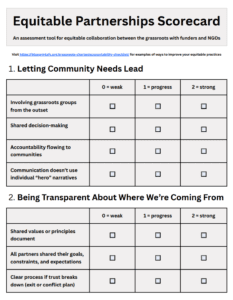
Download/print the tool here!
How can we make our partnerships more equitable?
1. Let Community Needs Lead
- Involve grassroots groups from the outset.
- Progress: Involving grassroots before the mid-way point of the campaign/project.
- Strength: Meeting agendas and/or co-created planning documents show involvement since beginning of campaign/project.
- Use shared decision making structures.
- Progress: Grassroots are somewhat involved in decision making.
- Strength: Formal agreements showing equal decision-making roles, shared governance models, etc.
- Accountability should flow toward communities, not only upward in institutions.
- Progress: At least a couple of opportunities per year for communities/grassroots to provide feedback.
- Strength: Community feedback mechanisms, participatory evaluation reports, etc. showing continuous feedback from communities.
- Respect collective leadership and avoid individual hero narratives.
- Progress: A mix of individual hero and collective leadership narratives.
- Strength: Messaging guidelines, community-approved communications, etc. that center collective leadership
2. Be Transparent About Where We’re Coming From
- Co-develop a ‘shared values’ document at the start of partnerships.
- Progress: Values document pre-drafted and shared with grassroots for review.
- Strength: Co-developed, signed shared values or partnership principles.
- Share origin stories, motivations/goals, timeframes and constraints.
- Progress: One-sided sharing, or informal discussion between a few members of the group(s), not collectively discussed.
- Strength: Partnership onboarding materials, meeting notes, project briefs etc. that show evidence of co-sharing on these items.
- Have exit or conflict processes prepared in case trust breaks down.
- Progress: Plan exists, but pre-drafted (not co-developed).
- Strength: Co-developed conflict resolution protocols, off-boarding processes.
3. Invest in Deeper, Long-Term Relationships
- Put time into building trust-based relationships.
- Progress: Occasional social/relationship building opportunities (at least a couple per year)
- Strength: Regular check-ins, relationship-building activities, etc. built into the work
- Address conflict and power dynamics through open dialogue.
- Progress: Naming conflict/power dynamics verbally. There is some effort to address, though limited.
- Strength: Conflict management procedures, power mapping exercises to move through conflict/power dynamics.
- Make funding or collaboration multi-year or renewable when possible.
- Progress: Grassroots able to reapply for funding and/or work with organization again within 3 years.
- Strength: Multi-year grant agreements, renewal criteria outlined.
- Support emotional labor and movement fatigue.
- Progress: Emotional labour and movement fatigue are named and recognized verbally.
- Strength: Wellness stipends, trauma-informed practices, etc.
4. Commit to Addressing Rising Fascist/Authoritarian Threats
- Have ongoing dialogue with grassroots groups on risks and challenges.
- Progress: Risk assessment discussion held at least a couple of times per year.
- Strength: Risk assessment discussions held continuously.
- Adapt strategies collaboratively to mitigate risks to the grassroots.
- Progress: Strategies adapted independently and presented to grassroots.
- Strength: Scenario planning outputs, protective protocols drafted collaboratively.
- Adapt funding or collaboration to account for National legal restrictions.
- Progress: Some regions and scenarios successfully adapted, other regions and scenarios avoided due to legal restrictions.
- Strength: Flexible disbursement models, alternative channels explored.
- Advocate for partners facing repression.
- Progress: Support for partners facing repression, though slow (i.e. needing approval first)
- Strength: Public statements, support letters, legal aid partnerships, etc.
5. Prioritize Learning and Be Willing to Change
- Make regular reflection and learning spaces part of the partnership.
- Progress: At least a couple of opportunities for reflection and learning per year.
- Strength: Learning logs, co-learning workshops, etc. consistently used.
- Feedback channels for grassroots partners that lead to tangible organizational change.
- Progress: Feedback channels exist. Follow through on feedback creating change is limited.
- Strength: Policy updates, internal memos referencing grassroots input, partner surveys, anonymous feedback tools.
- Non-traditional knowledge sources (oral, lived experience) are valued.
- Progress: Non-traditional knowledge sources encouraged and acknowledged. Limited evidence of inclusion alongside other forms of knowledge.
- Strength: Inclusion of community narratives in reports, flexible impact indicators.
6. Proactively Discuss and Challenge Barriers to Inclusion
- Identify and actively address barriers to participation upfront.
- Progress: Barriers to participation are identified. There is some effort to address them, though limited.
- Strength: Accessibility plans, needs assessments, reimbursements and stipends (for transport, childcare, mobility etc), access support logs etc. are used.
- Give the grassroots leadership and decision making power.
- Progress: Grassroots included in decision making, though leadership opportunity is limited.
- Strength: Leadership roles for grassroots members, participatory budgeting, etc.
- Center the Global South/majority and marginalized perspectives in decisions.
- Progress: Between 25-50% of decision makers in the organization are part of the Global South/majority and/or marginalized.
- Strength: Diverse advisory boards, Global South/majority-led processes.
7. Limit Financial Reporting and Funding Restrictions
- Simplify reporting requirements.
- Progress: Reporting requirements reduced from original requirements, though still relatively lengthy.
- Strength: Short-form templates, oral report options.
- Give flexibility on how resources can be used (within agreed values).
- Progress: Some flexibility on how funds can be used, though limited.
- Strength: Budget flexibility clauses, real-time amendment mechanisms.
- Make outcomes, not bureaucratic compliance, the focus of accountability.
- Progress: Long reports and compliance still expected, though outcome stories and impact snapshots still platformed/encouraged.
- Strength: Outcome stories, impact snapshots instead of long reports.
