This article summarizes an event hosted by the Global Grassroots Support Network (GGSN) on Fighting the Far Right, case studies + discussion, held on the 24th of September, 2026.
35 people joined us from Canada, Mexico, the UK, Belgium, France, Kenya, Uganda and India. The session was moderated by Kenzie Harris (GGSN coordinator) and the event featured the following speakers:
- Natasha Adams (Thinking Doing Change, natasha.adamscampaigns@gmail.com) – UK
- Kate Turner (Building Power Network, bpn-rpc@protonmail.com) – Canada
- Jacob Okumu (GGSN, jacob@blueprintsfc.org) – Kenya
- Anonymous speaker – India
Speakers gave an overview of the context in their countries, and shared specific examples to further understand the context and how the grassroots/NGOs are responding. The discussion reviewed the Gen Z protests in India, moving towards what we want (not just resisting what we don’t want) and tips for holding coalition building/strategic gatherings to fight the right collectively. The descriptions provided below mostly reflects the wording the speakers themselves used.
“Core advice for people doing this work, wherever youb are, is to, first of all, think about protecting your people and communities, because that’s a really important basis for doing anything else.”
Natasha Adams, UK
Natasha’s (she/her) work on Thinking Doing Change focuses on understanding things that are driving the rise of the right in the UK, how it’s impacting civil society and movements, and what movements can do about it.
The UK context
The UK has seen a rise of strong far-right parties in the shape of reform. Nigel Farage (Trump-like) could become the official opposition in the next election. The government in power, the Labour Party (which should be left), have adopted far-right rhetoric and policy around migration and disability. They’ve also labelled non-violent action groups such as Palestine action as terrorist groups.
The UK has seen a rise in racist violence on the streets. Unite the Kingdom, features the biggest ever far-right rallies and marches in the country. The Patriot Front vigilantes blocked the port of Dover to resist small boats (with migrants). Political threats plus far-right protests have shifted mainstream politics and discourse further to the right.

Photo from Natasha’s slides
How the grassroots and NGOs are responding
Towards Meaningful Action research by Natasha and colleague Jim Coe found that in NGOs and communities, there are impacts on wellbeing and safety, especially for marginalized folks. What’s more, discourse and policy is shifting to the right on many issues (e.g. the climate debate).
Natasha used an initiative called the Anti-Racist Movement by Black Lives Matter (BLM) and three other organizations, to illustrate the grassroots response. Koji Kyerewaa from BLM UK discussed the following in his speech about the power of organizing…
Two years ago, in the UK, there were riots. Asylum hotels were targeted, fires were set outside of them, and organizations retreated. Some of the asylum seekers in the hotels were left to put out the fires for themselves. The civil society sectoral response? Hundreds of charities wrote a letter condemning to the violence. They wrote to the Home Secretary.
Many charities closed their doors out of fear for safety concerns. Staff and volunteers faced racial abuse, and retreated. The organizing infrastructure to support and mobilize communities wasn’t there.
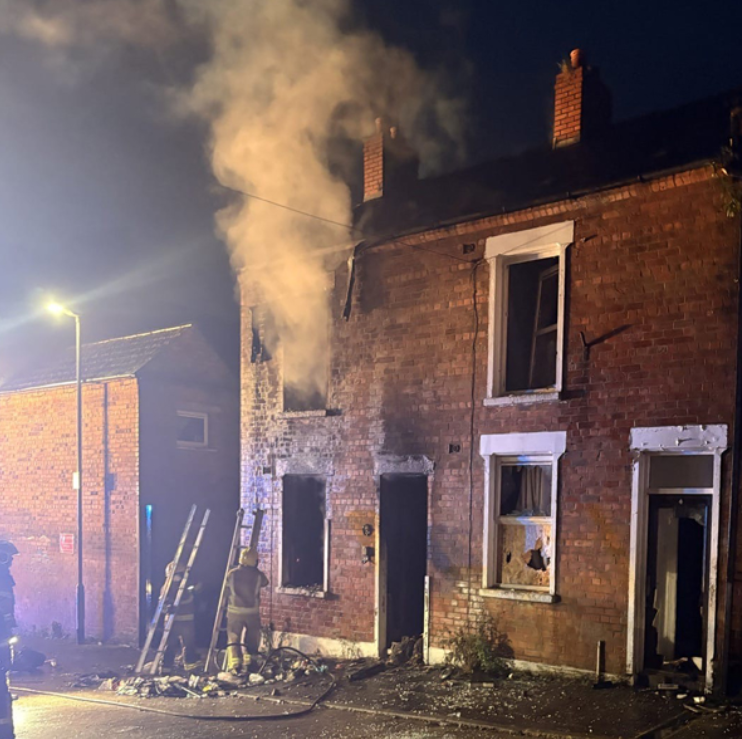
Photo of Belfast from Natasha’s slides
In early 2026, in Northern Ireland or the north of Ireland, there were racist riots after a Sudanese man stabbed a man from Belfast. The far right organized a violent response. There were headlines of masked people setting cars alight, families of colour being forced from their homes and onto the streets.
This time, the response was community-led. A collective called Annika Women’s Collective raised over £150,000 in one day for accommodation, transport and supplies, and they housed tens of thousands of people. Community organizations across Belfast found temporary accommodation for hundreds of people, and volunteers stepped forward to support. What made this possible was that the community relationships and infrastructure were already in place.
In Belfast, one of the members of the anti-racist movement arm has been training their migrant organizers. They’ve built relationships, trust, and capacity. Annika Women’s Collective runs 12 events and workshops every week. It’s self-organized, self-funded, and its members come from 27 countries. They didn’t stop this from happening, but they stepped in and supported immediately after it happened.
What’s happening and what’s needed
Natasha and Jim’s research report Meeting the Moment looked across the whole movement ecosystem. They identified five big categories, and lots of subcategories, of what is needed.
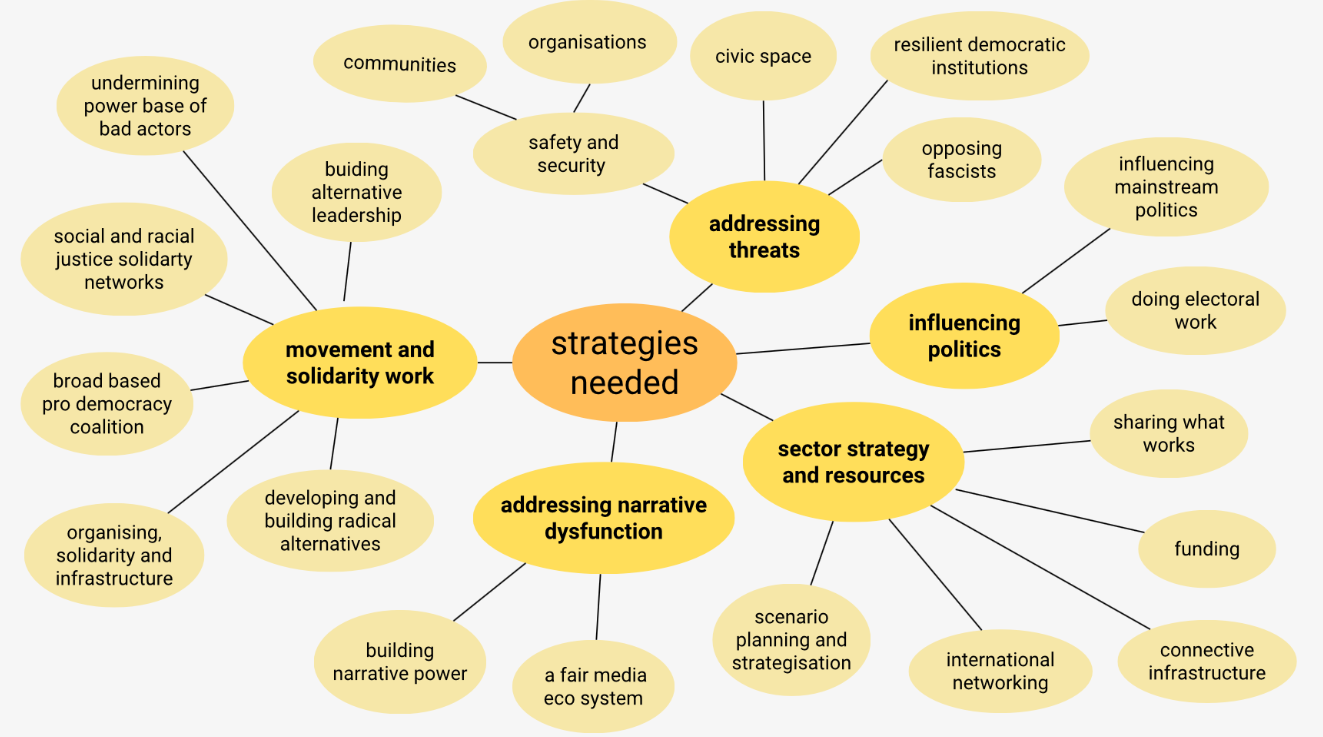
Photo from Natasha’s slides
The addressing threats category includes things such as addressing safety and security. For example, there’s a pooled fund to support migrant and racial justice organizations with any security needs, therapy, training etc.
The influencing politics category has seen lots of electoral work around recent elections. For example, climate groups teamed up with tactical voting initiatives and others to stop reform from getting in.
The addressing narrative dysfunction category includes building narrative power. One of the strategies used here is we’ve seen efforts to organize and engage content creators, many of whom don’t have a core focus on politics, to tackle online narratives.
The sector, strategy and resources category includes strategies like having one-to-ones, connecting and convening, and working to influence and advise organisations and funders about their strategy.
Natasha’s advice for people doing this work is to think about protecting your people and communities, as it’s the basis. Then you can start to think about which part of the ecosystem you can best contribute to.
“You might need to change your strategy, you might need to change your structure or your culture as needed to step in to kind of meet the moment and deliver the thing that is needed. Relationships are central to building power, so work collaboratively outside silos wherever possible. We need to work together to build power and fight back. Lastly, tend to the trauma and stress. Focus on hope and build in joy and care. Try and bring the world that you’re working to create into being through how you do the work as well.”
Kate Turner, Canada
Kate (she/her) works for the Building Power Network (BPN). BPN works to to advance capacity-building resources for folks across Canada who are defending their communities from far-right attacks, or working to oppose the populist right.
They’re producing intelligence reports that are actionable for grassroots movements. Through partners, they’re also giving people access to trainings and workshops, and legal and security resources. They’re also working to cultivate more cross-movement spaces to break out of silos and heal the fragmentation of the left in Canada.
The Canadian context
Canada is a settler colonial state. There is a history of a violent, occupying government on Indigenous land. The Indian Act legislated the creation of an apartheid reserve system for Indigenous peoples, took their right to vote, made certain cultural practices and cultural clothing illegal, and created the residential school system. Residential schools were a series of schools across Canada that kidnapped children and abused them in the name of assimilation. Unmarked graves are still being investigated.
Prime Minister Mark Carney has passed laws and policies to attack Indigenous rights, human rights, workers’ rights and the environment in the name of corporate interests and economic security. For example, Bill 5 is a law that pre-approves projects which are mostly situated on Indigenous land, without their consent. Bill C-2 is a law that blocks refugee claims. It will affect millions of people through the refusal to renew permits, leading to mass deportation. Carney is also pushing to enact a new law that would attack labor unions’ right to strike.
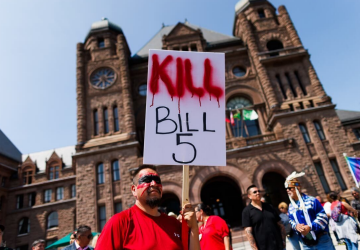
Photo from Kate’s slides
Canada has major corporate interests at play, especially fossil fuel and big tech companies. The biggest tech company is Shopify. It’s CEOs created a right-wing think tank called Build Canada. Build Canada produces policy memos aimed at the federal government. Increasingly, Carney’s government has enacted many of these memos.
Canada experiences foreign interference. One of the Canadian provinces, Alberta, is about to have a referendum on whether or not to separate from Canada. The Trump administration has been meeting with pro-separation groups, and there’s evidence that MAGA officials offered a loan to the Alberta Separation Movement to accelerate this.
Israel has also interfered in Canadian politics by manipulating public opinion about the genocide in Gaza, influencing news coverage and politicians’ statements, and creating fake social media accounts to spread Islamophobic disinformation. Israeli spyware has been used to dox and spread disinformation about pro-Palestine organizers in Canada.
Since 2023, Canadians no longer have access to mainstream news sources on Facebook and Instagram. This has resulted in the amplification of far-right political narratives and disinformation. One of the biggest actors is called Canada Proud, which is a network of hundreds of social media accounts that explicitly focus on returning our Conservative Party to power. Canada Proud has so many accounts that they’re able to create and shift political narratives. They spend millions of dollars on micro-targeted ads.
Far-right white supremacists and neo-Nazi groups are going door-to-door in communities outside of urban centers. They’re talking about LGBTQ+ positive education in schools, and about Indigenous land claims, falsely stating that an Indigenous land claim could threaten a person’s home or property. They’re also discussing ‘re-migration’ (also known as ethnic cleansing) to describe the deportation of over 10 million non-white people from Canada.
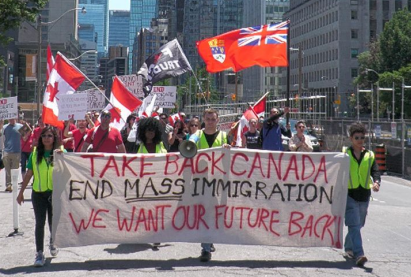
Photo from Kate’s slides
How the grassroots and NGOs are responding
Communities are developing multiple different strategies, such as forming a coalition between Indigenous communities and labor groups. In 2022, a coalition formed to evict a far-right convoy that was occupying Ottawa. In Montreal, several of these coalitions have come together to organize large public education events and protests. In Vancouver, where there is an explicitly far-right party campaigning for municipal seats, there is a progressive municipal party that is campaigning for 12 different seats.
There is bipartisan momentum in opposition to hundreds of data centers being proposed. Almost everywhere, there is resistance being organized by the local community, and that resistance is crossing political lines.
Indigenous resistance is leading the way. There are several Indigenous coalitions forming to push back on the legislative attacks that are happening across the country on Indigenous rights and on Environmental Protections and worker protections. This includes on-the-ground resistance land defense tactics, and legal counter moves.
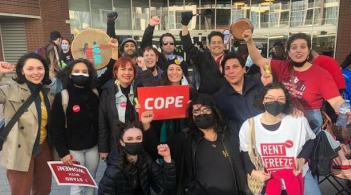
Photo from Kate’s slides
There are formalized coalitions emerging to connect folks to fight back, especially against Provincial level or federal level issues. Both in Ontario and Alberta, there are coalitions emerging to attempt to remove the leaders of those provinces who are right-wing and have been attacking and privatizing public services. There’s a national level group that emerged from ‘Draw the Line’ protests last year, which was the unification of, migrant rights, pro-Palestine, and climate justice groups.
A paper by Erica Chenoweth and Zoe Marks, called Pro-Democracy Organizing Against Autocracy in the United States, is a good resource for folks facing a global north context of rising authoritarianism.
The three pillars that the authors highlight in that paper are; 1) we need to have communication infrastructure that connects us across the entire left, 2) we need to focus on community power as a foundation of anti-fascist resistance, and once we have those things in place, and we are working more collaboratively, this is the only way that we can begin to advance 3) non-cooperation tactics, which could attack the pillars of power of a autocratic or a fascist regime.
Jacob Okumu, Kenya
Jacob (he/him) is a supporting coordinator for the Global Grassroots Support Network (GGSN). He is working with other leaders in the region on creating a regional network for grassroots movements in East Africa, to offer solidarity whenever there’s a challenge in any of these countries. His work with the GGSN also involves encouraging the sharing of tools, practices, and knowledge to support one another’s causes.
Gen Z protests and their influence
East Africa is seeing increasing authoritarianism, democratic backsliding, populist politics, civil space is continuing to shrink, youth disenfranchisement, disinformation, and state repression. East Africa operates like one community. In Tanzania, Uganda, and Kenya, leaders are operating in similar ways.
Two years ago there was a tax that was proposed by the government, the finance bill tax, that was going to make the life of Kenyans difficult. People rose against this tax. What was supposed to be just an opposition to this tax turned out to be a call to demand accountability, a call against corruption, and a call on economic injustice. Instead of using platforms the government was used to surveilling, young people used apps; TikToks, and Instagram and WhatsApp. This meant the government couldn’t establish who the leader was, or where it was operating from. It also produced many other smaller movements beyond the protests.
Civil society organizations are beginning to see that we cannot work alone to hold our government accountable. We have to bring in youth, NGOs and other stakeholders to make our movement stronger. Jacob saw this echoed in the recent ‘People’s Dialogue Festival.’ It brought together different stakeholders, including faith leaders who hold a lot of power within the church. People’s faith can be utilized to hold the government accountable.
Civil rights organizations are beginning to re-examine how they work. For a long time, they’ve been reactionary, but organizations, movement, activists are beginning to see that there is value in proper organizing, investing in information, technology, and that it takes a bit of time that hold the government accountable.
Organizing around upcoming elections
Kenya has an upcoming election, and organizers can anticipate how that election is going to turn out. There are signs from regional elections and by-elections; violence, the political climate, the violence that are in the campaigns, the words that politicians are using… they can anticipate the elections will not be peaceful. So, people are beginning to organize and ask questions. Mainly, how do we organize and prepare ourselves so that it doesn’t take us by surprise?
In Uganda, the National Resistance Movement Party has been in power for over 40 years. There has been efforts by opposition leaders, to organize youth to challenge existing powers. This has activated the political temperatures in the country. Grassroots activists continue to face arrests. They continue to be held in police custody for non-violent action. During Uganda’s election and post-elections, they couldn’t communicate because the internet was shut down by the government.
Grassroots movements are also beginning to recognize that we cannot just be organizing around elections and then post-elections, going quiet and waiting for the next elections. Organizations like Solidarity Uganda are helping activists to hold governments accountable outside of elections.
From Julius Okoth in the chat: Zambia, Uganda, South Sudan, Tanzania and Rwanda’s opposition leaders have all been locked up for “treason”. Kenyan Courts aren’t perfect, but they can make ruling not favouring the executive.
Showing up in solidarity across regions
For the region, Tanzania has been the hub of peace. In 2025, this got challenged when they held their election. The government learned from what Kenya was doing and what Uganda was doing, and the election turned violent. Activists were arrested, internet was shut down, communication became difficult. Activists in Kenya and Uganda crossed the border to support activists in Tanzania who fought back. Kenyans and Ugandan activists were also asking questions and demanding accountability from the Tanzanian government. When the leader of opposition in Uganda was arrested, lawyers from Kenya, and activists from Kenya and Tanzania rose up to ask questions. The hope is that this will lead to a regional push for accountability.
Interested in knowing more about the finance bill protests that happened in 2024? Read Jacob’s article here!
Anonymous speaker, India
Our final speaker, who has requested to remain anonymous, is working to fill the gaps in grassroots support in India.
The far right takeover
Social media was used to call actual historical facts into question. Media and advertising agencies built a cult-like image of Modi ahead of the 2014 elections. For 60-70 years, these organizations have infiltrated civil society spaces. India is large, diverse, and ethnically different. These organizations focused on these differences to sow hatred in Indian society. A fascist party would not have come to power had the previous government not been center-right. These governments chipped away at civil liberties. It is with this background that a fascist political party was able to take power.
In 2014, when they won a majority, the first thing that they did was capture media, which was easy because it was corporatized. Independent media bodies were attacked. Several journalists were murdered. They created an environment of fear, silencing voices that might have otherwise spoken up.
Next they closed down human rights and environmental NGOs. Greenpeace was the first NGO that they attacked, removing it entirely from the country. NGOs funding was taken away and licenses were canceled. Civil society was not organized at that point, and most couldn’t understand what was going on. The intelligence apparatus played a major role in capturing institutions, including civil society organizations. A similar parallel is the CIA in America.
Next they captured watchdog institutions, which ensure that governments are kept in check, and a balance of power is maintained. They also tried to capture Bollywood. While Hollywood is an effective propaganda machine, Bollywood has not been. While this was happening, Parliament was robbed of its powers. In democracies for an act or a law to pass, it must be debated in parliament. This was bypassed, and special powers were given to the Prime Minister’s office.
How citizens and opposition parties are fighting back
There were two key moments of opposition in recent years. The first thing the government tried to pass was the Citizenship Amendment Bill, which would give them the power to strip people of their citizenship. People targeted by this law would be Muslims and other minorities. By this point, there was significant civil society anger and opposition to what was going on. This resulted in large-scale civil society protests, led by Muslim women, against this bill. They occupied the streets and refused to leave, putting an end to the bill.
Another key moment was the farm laws that would have corporatized farming in India. This saw a similar takeover of streets, with protests by farming groups and farming unions. For more than one year, farmers were sitting on the streets, and they refused to leave, they refused to budge.
Something that shifted society’s image of the Prime Minister and his party was a political opposition leader who decided to go on a Yatra, or march. He called it the Bharat Jodo Yatra. The English translation is Unite India Rally, to acknowledge a level of polarization within Indian society that has never happened before. Family members are fighting family members, friends are fighting against friends, and neighbours are fighting against neighbours.
He walked from the southernmost tip of the country all the way to the northernmost tip of the country in Kashmir. When he started walking, civil society organizations and community members started joining him, walking alongside him. Things that are going wrong in the country, started coming out. Despite that mainstream media did not want to cover it, they were forced to cover it because so many independent social media influencers were amplifying it. Social media influencers, stand-up comedians, civil society organizations, and political opposition parties started talking about misinformation and the propaganda that the government was doing, and mainstream media lost credibility.
Massive student protests happened this year, and the reason behind those protests is that the government’s policies that have resulted in unemployment and disrepair. As of this year (2026), Modi himself, and his government are having the least amount of popularity that they’ve had since they’ve come to power.
Interested in knowing more about the rise of authoritarianism in India? Read the article here!
Discussion
Gen Z protests in India
Aslam: GenZ movement in India exposed the fascist government.“It’s impacted the political spectrum of the country itself… especially the role of young women in the whole movement.” “There are two things that happen in this movement. One is to tarnish that image. The second thing is overcoming the fear. The fear that they had.”
Anonymous speaker: The protests resulted in the resignation of one of Modi’s cabinet ministers. “The Gen Z protest has not happened in isolation, and it would not have happened unless and until these previous groups that fought, the farmers, the Muslim women, the Shinbach protests that happened against the citizenship Amendment Bill, without those happening, this probably would not have happened.”
Moving towards what we want
Farrah: “I’m putting on events to work with Black people to process the effects of trauma, racial trauma. My question is… what can be done around not just working with resistance and talking about what we don’t want, but also what we do want… what needs to be put in place so that, systems are more in favour of human beings as opposed to corporations, or far-right, or anti-human sentiment?”
Natasha: “I didn’t go into the detail of the research that Jim and I did, but there’s all sorts of different things that we think are needed, not just resistance to it, but also… kind of imagining the world that we want to live in, and creating that.. there are so many levels that we can address this on… the work that you’re doing sounds so important, because this is a lot for people to hold and process, and I’m finding that any sort of event that I go to, that there needs to be a rural arc to support them through it, and to manage the emotions.
I think, actually, a lot of the problem that we’re seeing is that the emotions that this brings up are so big that a lot of people are just shutting down, and they’re not actually able to stay with it, because they just get such a strong fear response… that response is different depending on how much you are personally directly affected by what is going on…
I was at the World Times gathering that the Social Change Nest put on… there were lots of people talking about, regenerative futures work, participatory local work, how we create the world that we want in what we’re doing, and how we push for change, as well as fighting back, and all of those things. And I feel like there are lots of things happening. It’s easy to focus on the difficult parts of this. I do feel hopeful, and I do feel like there’s a lot of possibility and a lot of good people doing brilliant stuff.”
Kenzie: Emphasized that grief work is central to the disability community, and is necessary to reach a level of creativity that’s harder to access if you haven’t processed your grief. The work Farrah is doing is an important part of moving towards what we do want.
Kate: Shared that in so-called Canada there’s a focus on “uplifting Indigenous knowledge and Indigenous stewardship, especially when we’re talking about land and cultural practices and, just the protection of ecosystems.”
Holding coalition building/strategic gatherings to fight the right collectively
Kenzie: “There are groups that are coming together, and they’re trying to hold these sort of gatherings to do coalition building, or thinking about a common strategy across issue lines, or across organization lines. I wonder for other organizations here, or other people who are part of groups that maybe want to host something like that, if you have any advice for what supported you in that process in holding what were effective gatherings?”
Farrah: “I had an experience, where I had to travel… for an interview… and it meant leaving a very multicultural, relatively safe space to a place where I knew would be majority white, and with tensions rising around race… there was a lot of terror that I experienced, and when I got really ill… I had a really bad cough and a cold, but as soon as my train pulled back into Kings Cross, my cough abated, so that indicated the physical stress, I guess, and impact, the psychosomatic impact of it.
I decided that I would put on an event to create space for people to… talk about the impact of racism… to start processing, because there is research that indicates that racism has not just mental issues, but can cause physical ailments as well in the long term. And so the structure that I put in place, just given the training that I’ve done, and, other things that I’ve done around… processing emotions and raising consciousness, is that in the first section, there was a space for people to surface their emotions, because I think that’s what people often come in with is the big feelings…
Giving people that space to… talk about their emotions, their feelings, what they’re affected with, then created space for dialogue… I had a panel discussion after where we then spoke about the psychology of racism, and that meant that because those emotions had been dealt with or processed as much as they could be in that time, it meant that [it was] much more kind of fruitful. It seems important that the emotional side is recognized as part of any gathering, really, whether it’s before, during, or after, but probably before, to clear the way for a fruitful discussion, in line with whatever the objective is of that gathering.”
Kenzie: “Yeah… I’ve definitely been to coalition-type gatherings where that wasn’t present, and so there were tensions that gathered as we were having these strategic discussions. So, doing that proactive work is… something that’s often missing in these spaces.”
Natasha: “There have been quite a lot of gatherings in the UK to talk about this, but a lot of them have ended up centring the problem, rather than what can be done, and there’s been a lot of things that should be the beginning of a process, but they’re just an event that then is left hanging, and there have been some processes. I’ve been trying to get funding to do something more sustained with very limited success.
I’ve started doing unfunded, some convening of conveners that have started convening in their different spaces to build up a bit of momentum and relationships between people… we’re really thinking about how do you take that towards action, and I think the only way that you can really get different people to collaborate is by building relationships and building trust, and that takes time and needs some process.
But also, with getting people together, there’s a real balance between having an agenda that is very structured, and is too structured, and doesn’t allow space for things to emerge, and it being completely unstructured, and yeah, there’s nothing to kind of pull it together and identify those things, and then take it forward. So it’s really thinking about a balance.”
Hilal: Finished our discussion with a lesson from their work with Ulex, which was to “hold our opinions lightly,” rather than “my theory of change is better than yours,” etc.
