
This article summarizes an event hosted by the Global Grassroots Support Network (GGSN) on January 27th, 2026. This call emerged from conversations in East Africa around elections, as Tanzania, Kenya and Uganda are considering the role of elections following and in preparation for National elections in their countries.
GGSN members were considering: We have people who are valued driven leaders who present themselves for election, who build power. But after elections, what’s your role? What skills and knowledge have you gathered? How can that be deployed to continue momentum, and to prepare for the next elections?
Quotes from group discussion have been anonymized.
In many countries, elections are increasingly untrustworthy avenues for change
Organizers from Kenya, Uganda, India, Japan, and the U.S. agreed that elections are not always democratic in practice—especially in increasingly authoritarian systems. But, even flawed elections can still be used as tools for organizing, relationship-building, and resistance, rather than just as moments to win or lose seats.
“In places like ours, do elections really matter — and if not, how do we turn them into tools for organizing and resistance anyway?”
Examples of how organizations around the world respond
We looked at 5 examples to map the different roles that organizations are taking to build power and lead to success in the elections that follow; base-building, political education, policy campaigns and internal pressure.
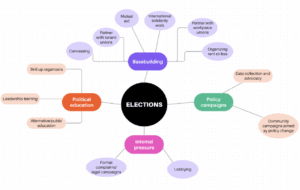
Example 1: Democratic socialists of America. After losing key races in 2022, NYC-DSA:
- Ran local policy campaigns and won in 2023
- Built tenant and worker bases (rent strikes, unions)
- Coordinated mutual aid and solidarity networks
- Used mass door-knocking to support organizer-candidates → culminating in Zohran Mamdani’s 2025 mayoral win
Example 2: After Labour won in 2024, Momentum UK:
- Trained organizers in political education
- Applied internal party pressure through policy and leadership organizing
Example 3: After winning a congressional seat in 2025, Gabriela in the Philippines:
- Filed electoral fairness complaints
- Continued grassroots organizing on women’s health, labor, and migrant justice
- Advanced international solidarity work
Example 4: After 2024 elections, KA.DER Türkiye:
- Documented gains/setbacks for women in politics
- Advocated legal and structural reforms
- Ran public education and media campaigns on gender and participation
Example 5: Future Elects Africa prepares candidates year-round through:
- Leadership development programs
- An app for entry-level political education
“These candidates reflected deeply on what they built during the election process. They took notes and made a commitment not to let that power disappear. They deliberately organized around the same resources they had developed — the people, relationships, understanding of the community, and their ability to communicate in inspiring ways. They used all of it to keep holding their government accountable.”
Individuals and grassroots organizations have roles to play outside of elections
Are we ready for the next election? Or are we just preparing to defend ourselves again instead of shaping the narrative and strategy?”
Real power is built through:
Educating your community.
“Voter registration numbers in Kenya — especially among youth, who are the majority — were extremely low. That tells us something is wrong with how we organize. Either people have lost faith in the system and don’t believe they can create change, or they’ve become completely disengaged.”
Bringing community members together.
“Because of social media, nuclear families, and migration, many families are scattered… We don’t talk to our neighbours… There’s little unity and a weak sense of collectivism — less recognition that we are interconnected, and that harm to one group eventually affects everyone.”
Understanding different community interests.
“Even though I didn’t win the seat, I carried these [electoral campaign] lessons back into my activism. Now, when I’m in community dialogues or organizing spaces, I always ask: Who should be in the room? Who has influence here? Who has a direct interest in this issue?”
Valuing everyone’s contribution (knowledge, skills, influence, connections—not just money or titles).
“During protests in Kenya in 2024, many of the people who showed up were young people with no formal roles or titles. But they had numbers, energy, and commitment. And that mattered.”
Showing up consistently in small, practical ways.
“We’re helping [young people] submit written memos [in budget hearings and development forums]. And when they do, about 90% of those ideas actually make it into county or national plans. That shows people that participation works.”
Documenting abuses of power.
“Even in that [internet shutdown], people on the ground kept documenting abuses and injustices. When the internet was restored, we shared everything. We had planned for repression, and that preparation mattered.”
Calling on National and International networks of solidarity for support.
“We saw African and global leaders respond — and that shifted attention and pressure toward what was happening in Uganda.”
Building a base that is ready to mobilize in key moments.
“They didn’t know when the next election would be, so they wanted to make sure their base had built enough power that, whenever an election was called, they could mobilize immediately.”
Building resilient grassroots structures.
“You need a framework that consistently invites people in, provides moral clarity about what you’re trying to accomplish, and brings others along in the work… it needs clear goals, clear processes for onboarding people, and defined resources.”
Investing in leadership development.
“I’ve seen movements fizzle out again and again because of weak leadership. And we don’t invest enough in cultivating new leaders.”
